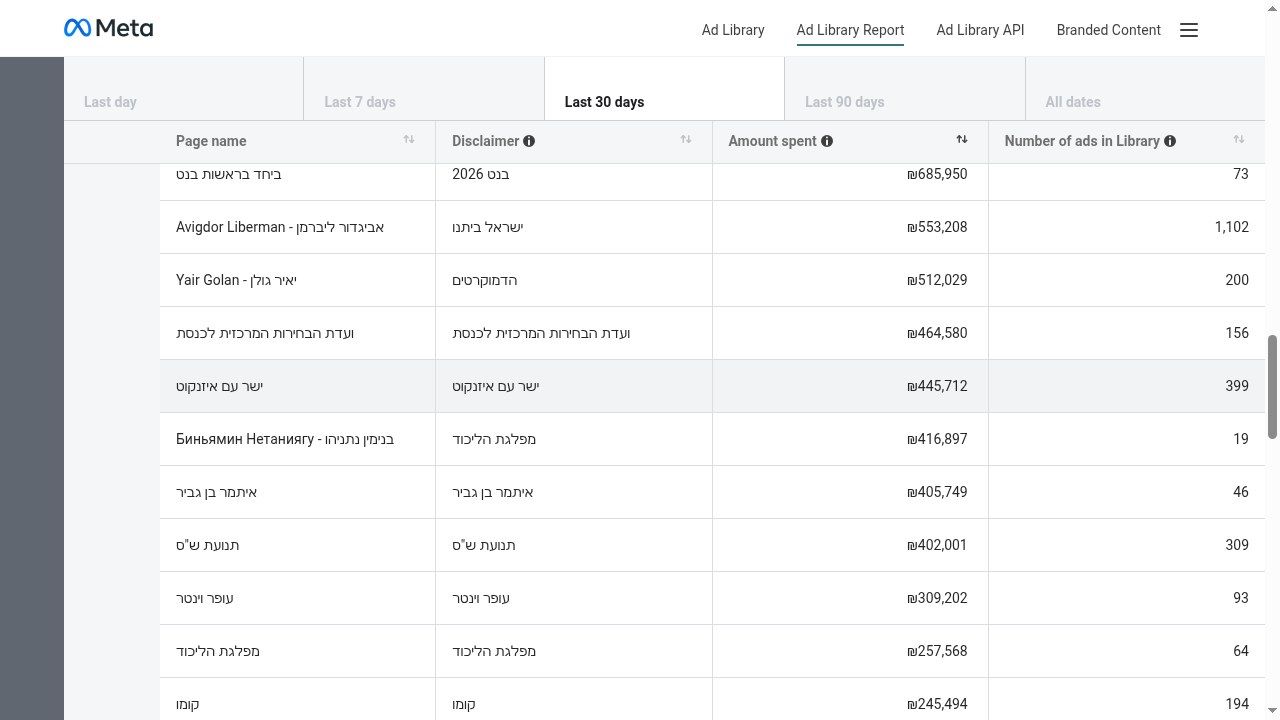

The election is also being fought in our feeds. To understand the scale of the advertising, we checked Meta's Ad Library report for Israel. The data, pulled on October 30, 2026, covers a 30-day window, September 28 to October 27. The review refers to the 20 pages with the highest spend in the report, not to every party's full advertising activity.
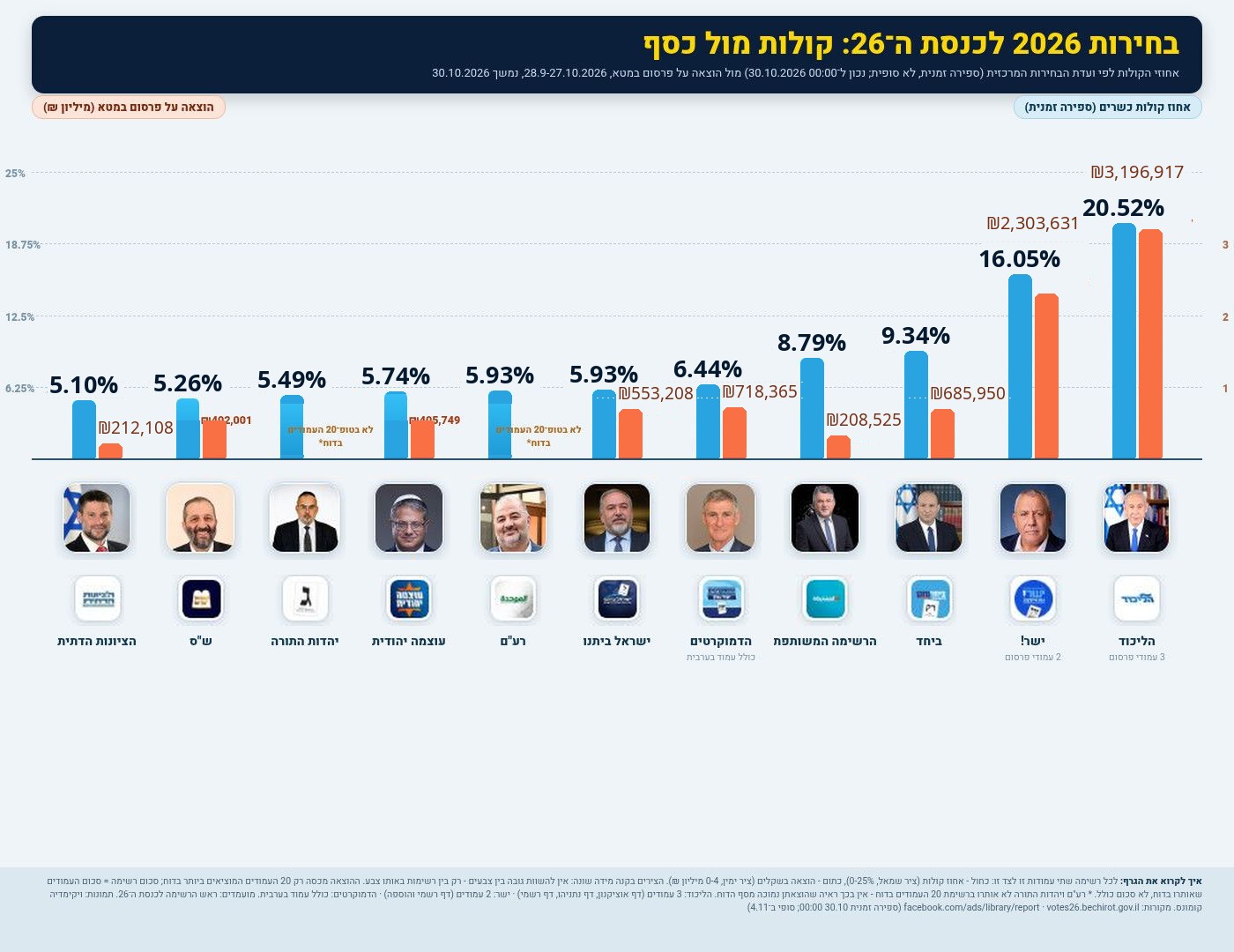
Alongside the spend, we show each list's share of the vote according to the election committee's provisional count, as of October 30 at 00:00. These are not final results. Placing the data side by side describes advertising activity and voting, and does not prove that advertising caused any specific result.
Likud on top, Yashar right behind - who spent what in the feed?
The data collected from Meta's report shows the 20 pages with the highest ad spend in Israel during the 30-day review window (28.9.2026 to 27.10.2026). When the pages associated with the same list are added up, the Likud party leads the table, having poured a huge sum of ILS 3,196,917 into paid Meta advertising through 3 different pages that made the top-20 list. Note: this is the sum of the pages identified in the report only, not necessarily the party's full campaign spend. At the same time, according to the Central Elections Committee's provisional count (30.10.2026 at 00:00 - not a final count), Likud's vote share stood at 20.52%.
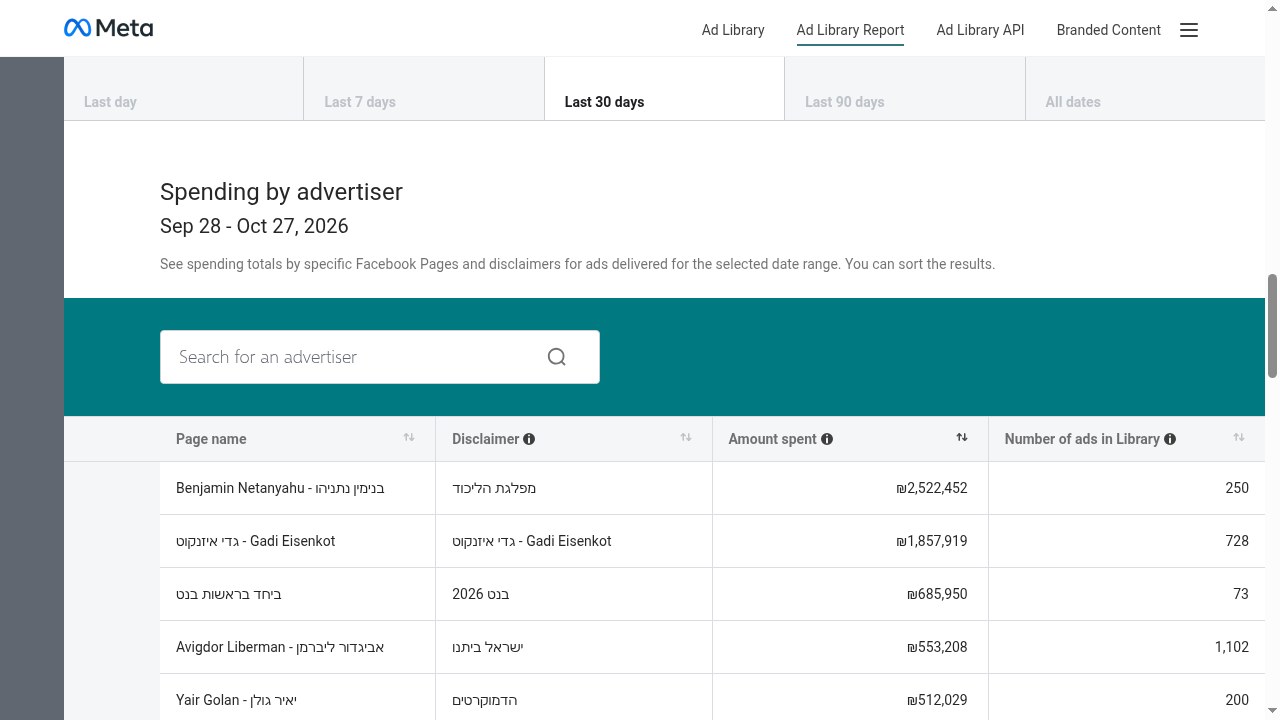
Second in the top-20 list is the Yashar party, showing a massive digital presence with ILS 2,303,631 spent in the reviewed window, split between 2 prominent pages on the list. On the provisional vote count, Yashar reaches 16.05%.
The BeYahad list appears in the report with ILS 685,950 spent through a single page that made the top 20, and a 9.34% vote share in the provisional count.
The Joint List also appears in the report: it recorded an 8.79% vote share and spent ILS 208,525 through one page on the report's 20 largest pages.
The Democrats party spent a total of ILS 718,365 through 2 pages in the top 20, one of them an Arabic-language page. The Democrats' provisional vote share stood at 6.44%.
The mid-sized and smaller parties also invested significant sums in the feed.
Yisrael Beitenu recorded a 5.93% vote share and ad spend of ILS 553,208 through one page included in the report.
Otzma Yehudit won 5.74% of the vote and invested ILS 405,749 in advertising (one page in the report).
Shas received 5.26% of the vote, alongside ILS 402,001 spent on Meta through one page in the report.
Religious Zionism recorded a 5.10% vote share and spent ILS 212,108 through one page that made the report's top 20.
Beyond the political parties, the official body running the election also made extensive use of the platform. The Central Elections Committee itself spent ILS 464,580 in the reviewed data window (28.9.2026 to 27.10.2026), for voter information and turnout encouragement.
Likud
- Meta spend in sample
- ILS 3,196,917
- Vote share, provisional count
- 20.52%
- Pages in top 20
- 3
Yashar
- Meta spend in sample
- ILS 2,303,631
- Vote share, provisional count
- 16.05%
- Pages in top 20
- 2
The Democrats
- Meta spend in sample
- ILS 718,365
- Vote share, provisional count
- 6.44%
- Pages in top 20
- 2 (including an Arabic-language page)
BeYahad
- Meta spend in sample
- ILS 685,950
- Vote share, provisional count
- 9.34%
- Pages in top 20
- 1
Yisrael Beitenu
- Meta spend in sample
- ILS 553,208
- Vote share, provisional count
- 5.93%
- Pages in top 20
- 1
Otzma Yehudit
- Meta spend in sample
- ILS 405,749
- Vote share, provisional count
- 5.74%
- Pages in top 20
- 1
Shas
- Meta spend in sample
- ILS 402,001
- Vote share, provisional count
- 5.26%
- Pages in top 20
- 1
Religious Zionism
- Meta spend in sample
- ILS 212,108
- Vote share, provisional count
- 5.1%
- Pages in top 20
- 1
The Joint List
- Meta spend in sample
- ILS 208,525
- Vote share, provisional count
- 8.79%
- Pages in top 20
- 1
Vote shares from the provisional count, 30.10.2026 at 00:00. Not a seat count and not final results.
Missing from the top 20 - Ra'am and United Torah Judaism outside the leading pages
One of the more interesting phenomena in the data is the absence of certain parties from the report's 20 leading pages. Ra'am, which received 5.93% of the vote, and United Torah Judaism, with 5.49%, do not appear with pages among the report's 20 largest, and no total amount was located for them in the reviewed list.
An important, transparent rule of inclusion must be made clear here. A party's absence from the report's top 20 pages is not evidence that its total spend is below the list's lower threshold (ILS 192,001). Their total spend may be very high, but spread across many smaller pages, none of which individually crossed the threshold needed to enter the top 20.
How to read the numbers correctly
For the comparison to be useful, it is important to define what the data measures and what it does not.
Two axes in different units: vote share (in percent) and ad spend (in shekels) are two axes in completely different units. The comparison is valid only at the level of analyzing general trends and patterns.
A limited time window: the spend data covers only a 30-day window (28.9.2026 to 27.10.2026) and the 20 largest pages only. It should not be read as the parties' total spend over the whole campaign period.
We do not calculate a "cost per vote" or "cost per impression" here: the spend data is a sample of pages in a limited window, and Meta's impression data is shown in ranges at the ad level. Combining them is no basis for such a calculation, and certainly not for inferring a causal link between spend and votes.
Where does the money come from? The economics of election funding
To understand how parties can pour millions of shekels into digital campaigns before the polls even open, you need to know how party funding works in Israel. A comprehensive study by the Israel Democracy Institute (by Dr. Assaf Shapira) reveals a striking figure: in the 2022 election, 99.7% of Israeli parties' income came from state funds - about ILS 206 million out of a total income of ILS 207 million. Public donations totaled only about ILS 250,000, and other sources (such as primaries registration fees) came to about ILS 370,000.
The reason for the near-total dependence on public money lies in the combination of generous state funding and strict limits on private donations. The law states that an Israeli citizen and their household may donate, in an election year, a maximum of only ILS 2,800 to a party serving in the Knesset (and up to five times that, ILS 14,000, to a party not represented in the Knesset).
How do the 2026 election advances work?
To allow parties to finance the campaign's ongoing expenses, the state transfers advances on account of the election funding.
New parties are entitled to an advance worth 10 funding units, instead of the usual 7, under the temporary provision for the 2026 election. Receiving the advance is conditional on a bank guarantee, for which private guarantees are sometimes raised. Two units are given already on the cutoff day, and the remainder after the candidate list is submitted.
Established parties are entitled to an advance in funding units equal to 80% of their number of Knesset members on the cutoff day, instead of the usual 70%. By the formula, 32 MKs means 25.6 funding units, and 11 MKs means 8.8 units. Parties with fewer than 10 MKs can receive an advance as if they were represented by 10, subject to a guarantee for the difference.
In addition, while parties' previous debts to the Knesset are normally offset from the advance, a special temporary provision for the 2026 election set that only half (50%) of the debt would be offset, leaving the parties with high liquidity for the campaign.
Private guarantees and debts carried between elections
A look at the State Comptroller's updated reports (on statements-p.mevaker.gov.il) reveals the enormous scale of private guarantees put up for new parties and joint lists ahead of the 2026 election.
The Yashar party put up guarantees totaling a record ILS 38.5 million.
The BeYahad list put up guarantees of ILS 11.5 million.
These guarantees are especially critical given the financial history of Israeli election campaigns. Israel Democracy Institute research shows that most parties end election campaigns in heavy deficit. In the 2022 election, for example, Likud received about ILS 51 million in funding but spent about ILS 57 million. In all, after the previous round of elections, Likud was left with a debt of about ILS 72 million to the Knesset, while Yesh Atid was left with a debt of about ILS 23 million.
What happens when a party does not enter the Knesset?
New parties that did not pass the electoral threshold: the state can confiscate the bank guarantee money they put up (as happened to Eli Yishai's "Yahad" party in the 2015 election).
Established parties voted out of the Knesset: they find it very hard to repay deficits without ongoing funding, creating "bad debts" of millions of shekels left with the Knesset - as happened in the past with parties such as The Jewish Home, Independence (Ehud Barak's party) and Tzalash (the party on whose basis Yamina and the New Right ran).
The spending caps set by law
To prevent uncontrolled budgetary excess, the Party Funding Law sets a defined spending cap. An established party represented by up to 5 MKs may spend up to 10 funding units (about ILS 14 million), while a large party like Likud reaches a spending cap of about ILS 97 million. For new parties, the initial cap is 10 funding units, but if the party wins more than 5 seats, the cap grows retroactively according to the number of seats actually won. Exceeding the spending cap can lead to sanctions and to losing part of the election funding, by decision of the State Comptroller.
As for joint lists (such as the Joint List of Hadash, Ta'al and Balad): they are entitled to a one-time addition of 1.4 funding units per list. In addition, for calculating the advances, the donation cap and the spending cap, the joint list counts as a single unit.
The 2026 election proves once again that your feed is worth a great deal of money. With millions of shekels flowing into sponsored ads every week, huge advances of state money and private guarantees in the tens of millions, digital advertising has become a central arena of the Israeli election campaign.