
Hebrew source: https://mediak.co.il/guide-577
Introduction
Selecting an audience targeting strategy in TikTok Ads Manager has undergone significant transformations. Alongside traditional manual tools - such as Broad targeting, Interests, and Lookalike audiences - the platform integrated the Smart+ system, which is based on automation and artificial intelligence. Advertisers and agencies in the field report that handling targeting is not a simple question of "automated vs. manual", but rather requires an understanding of the unified creation interface, setting rigid boundaries for the system, and managing automation components. This guide is based solely on documented experience from advertisers, consultants, and agencies in the field, presenting the workflows, advantages, and risks of each approach.
The New Architecture: Smart+ Modularity and Unified Creation Interface
Thomas Walker, founder and CEO of advertising agency Atlas MKT, explains that TikTok unified the manual and automated creation paths into a single interface (Unified Campaign Creation Flow). The primary change is that the system now allows setting the level of automation module by module - separately for targeting, budget, placements, and creative - instead of requiring an "all or nothing" scenario. The unified interface is available for Traffic, Sales, Lead Generation, and App Promotion objectives. Walker and advertisers on Reddit note that the rollout of this update is staggered (Staggered Rollout), so setting availability may vary between accounts and regions.
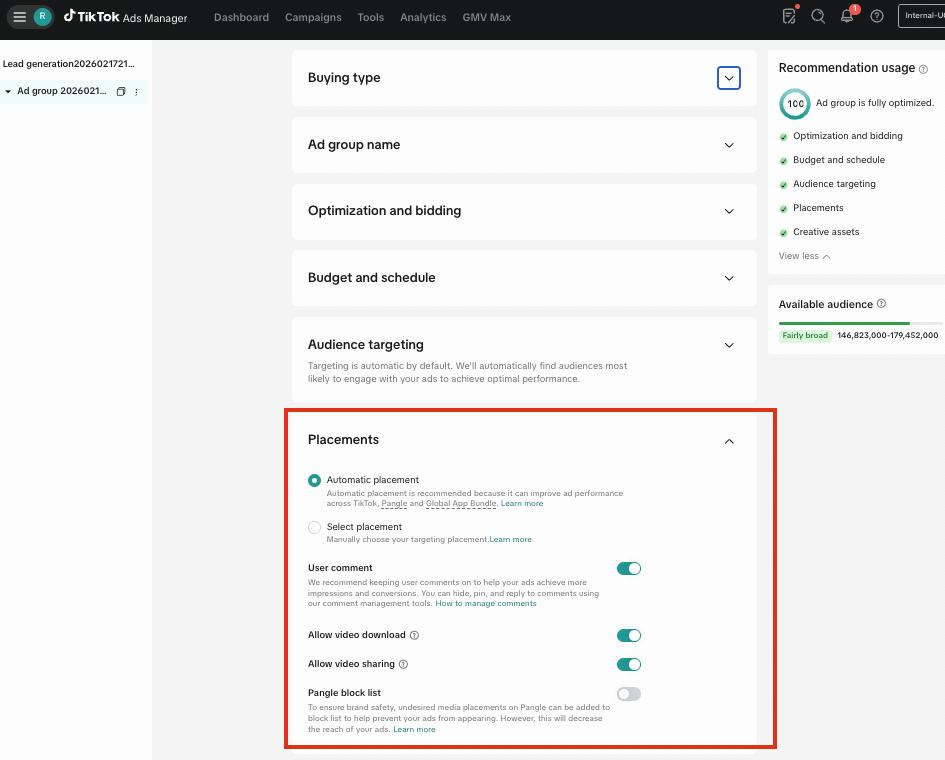
This example is from a lead-generation ad group. It illustrates placement controls, not a universal list available for every objective.
Campaign Structure and Distinguishing Between Control Types
According to Walker, the upgraded structure allows running multiple ad groups within a single Smart+ campaign, where each ad functions as an Asset Group containing up to 50 separate creative assets, catalogs, and destination links. Regarding targeting, Walker emphasizes a critical distinction between two types of settings:
Enforced Audience Controls: Settings that the algorithm is not permitted to override. These include geographic location, minimum age, language, and audience exclusions (Audience Exclusions). If a business operates in a specific area only, it is mandatory to define this within the enforced controls.
Audience Suggestions: Recommendations only (such as expanded age ranges, gender, interests, and behaviors). The algorithm uses them as a starting point, but is permitted to expand beyond them if it identifies conversions.
Additionally, there is an option for Custom Targeting, which restores full manual control (including purchasing power, household income, and device characteristics). However, Walker notes that TikTok warns that narrow manual settings may restrict ad distribution and harm performance.
Manual Targeting: Broad vs. Interests and Field Experiments
Broad Targeting and the Risk of Algorithm Drift
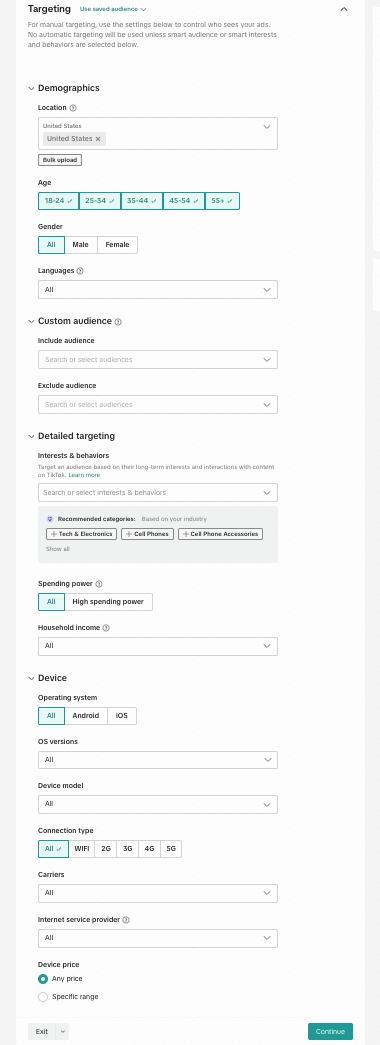
Example manual-targeting controls. Options and whether they restrict or suggest delivery depend on the campaign flow and account.
In conversion-based advertising, the Broad approach (without interest restrictions) is considered prevalent. However, an anonymous advertiser on Reddit (handle u/JoskoTimber) presented a case study in which he ran a Broad campaign for a toy store in the US (ages 18-55+). The campaign spent $140 and yielded only 3 conversions with an expensive CPC of over $3.5. Upon checking the Audience Insights tab, the advertiser discovered that the top ten interests to which the algorithm routed ads were gaming, digital devices, sports equipment, kitchen products, and financial services. These were the interests reported by the advertiser; the post does not establish that those categories caused the campaign result. Source:https://www.reddit.com/r/PPC/comments/1dyif0o/tiktok_broad_targeting_wrong_audience/
Auto Targeting vs. Broad in Apps
The team at advertising agency Admiral Media conducted a controlled experiment comparing Auto Targeting vs. Broad across different countries (France, Spain, and Germany) on Android and iOS operating systems:
In this February-March 2022 Android experiment, Admiral Media reported better results for Auto Targeting. Germany showed a 56% reduction in Cost per Tutorial Completed; France and Spain showed favorable traffic metrics. These are historical case results, not expected improvements for every account. Source:https://admiral.media/new-tiktok-auto-targeting-feature-what-is-its-impact/
On iOS apps: Mixed results were obtained. In France, the Broad group achieved a 10% cheaper Cost Per Install (CPI), but Auto Targeting achieved higher-quality conversions further down the funnel. The agency recommended pushing Auto Targeting on Android, but testing cautiously on iOS.
Smart+ vs. Manual Targeting in E-Commerce
Nicolas Rentschler from advertising agency Propellernet documented an experiment in which a manual structure (which included retargeting, interests, and Lookalike audiences) was replaced with a Smart+ campaign. Following the budget transfer to Smart+, spend increased by 24%, clicks surged by 180% (thanks to a 34% increase in CTR and a 55% decrease in CPC), and sales volume in GA4 rose by 126%. The reported Cost of Sale improved from a previous GA4 average of 25%-30% to 13.8%. Propellernet published this case on July 28, 2025. The budget and campaign structure changed, so these observations should not be read as a controlled causal estimate or a forecast for other advertisers. Source:https://www.propellernet.co.uk/insights/is-smart-the-future-of-tiktok-advertising/
Numbered Steps for Building and Testing Targeting in the Unified Interface
According to guidelines from Thomas Walker (Atlas MKT), agency Admiral Media, and advertisers on Reddit, the recommended sequence of actions for setup and testing is:
Tracking Audit: Thomas Walker warns that if conversion tracking (Pixel and Events API) is unreliable or does not prevent duplicate data, Smart+ will optimize aggressively toward false data. It is mandatory to verify that purchase events pass real values before activating automation.
Choose the targeting and bidding controls actually offered by the campaign flow. Confirm which selections are restrictions and which are suggestions. Availability can differ between accounts and campaign types; do not assume one universal Smart+ on/off switch.
Setting Enforced Controls: Setting geographic location, minimum age, language, and exclusion of existing customers as rigid boundaries that the system is not permitted to cross (Thomas Walker).
Entering Audience Suggestions: Entering demographic and interest settings as recommendations only, while allowing the algorithm to expand beyond them if necessary (Thomas Walker).
Review automated creative before delivery, especially for regulated offers or a strict brand voice. Disable or limit individual enhancements where supported if they alter the intended message or make a clean test impossible.
Parallel Run for Two Weeks: Walker recommends not transferring the entire account at once. Choose a single campaign with sufficient conversion volume, rebuild it in the upgraded Smart+ structure, and run it in parallel with the existing structure for at least two weeks before making decisions.
Errors Reported by Advertisers
Advertisers in the advertising community point to a series of failures when using Smart+ and automated targeting:
In a September 2025 Reddit thread, u/NaturalInitiative472 reported unwanted AI changes to uploaded creative. A later comment by u/PRandwine described an English voiceover added to non-English ads. These are advertiser reports, not proof that every Smart+ campaign makes these changes. Check the final previews and the available creative controls. Source:https://www.reddit.com/r/TikTokAds/comments/1npg81d/tiktok_ads_recent_update_is_horrible/
In December 2024, u/Shaglock reported $50 per conversion on the first day of a Smart+ campaign versus about $2 in an existing manual campaign. This is one advertiser report, not proof that Smart+ performs worse in every account. The post does not establish that the account itself was new. Source:https://www.reddit.com/r/TikTokAds/comments/1hj4qm0/how_long_does_it_take_for_smart_campaign_to_learn/
A January 2026 comment by u/ziroox criticized traffic from TikTok partner platforms. Treat this as one advertiser's opinion, not an audit of all partner inventory. Review actual placement and downstream results where the account permits. Source:https://www.reddit.com/r/TikTokAds/comments/1npg81d/tiktok_ads_recent_update_is_horrible/
In the same thread, u/Miserable_Mind9664 attributed poor campaign results to bot traffic and said budgets moved to Meta. The comment does not independently establish bot traffic as the cause. Source:https://www.reddit.com/r/TikTokAds/comments/1npg81d/tiktok_ads_recent_update_is_horrible/
Krystal Scanlon's October 15, 2024 Digiday analysis discusses transparency and the risk of budget reaching lower-value inventory under automated buying. It is industry analysis, not a controlled finding that automation always worsens inventory quality. Source:https://digiday.com/marketing/as-tiktok-rolls-out-smart-marketers-grapple-with-ais-advertising-puzzle/
Where Sources Differ or Are Unclear
1. Effectiveness of Smart+ vs. Manual Targeting
Propellernet's July 2025 case reported higher GA4 sales and a lower Cost of Sale after a move to Smart+. The dated Reddit reports above describe different outcomes in different setups. Thomas Walker recommends controlled testing; Courtney Shaw, quoted in Digiday in October 2024, says automation does not replace critical thinking, cross-platform learning or audience insight. These sources support testing and oversight, not a universal winner. Sources:https://atlasmkt.co.uk/blog/tiktok-smart-plus-new-controls andhttps://digiday.com/marketing/as-tiktok-rolls-out-smart-marketers-grapple-with-ais-advertising-puzzle/
2. Can You Continue Running Fully Manual Campaigns?
The September 2025 Reddit thread contains conflicting accounts: some contributors could not create or duplicate a manual campaign, while another reported that manual choices remained in other accounts. Walker's later account of the unified flow describes modular controls. These observations do not establish universal removal of manual campaigns. Inspect the options in the intended account. Sources:https://www.reddit.com/r/TikTokAds/comments/1npg81d/tiktok_ads_recent_update_is_horrible/ andhttps://atlasmkt.co.uk/blog/tiktok-smart-plus-new-controls
3. Broad Targeting - Does the Algorithm Always Find the Right Audience?
Admiral Media's historical experiment compared Auto Targeting with Broad, not broad with narrow interest targeting. Its Android results favored Auto Targeting, while iOS results were mixed. The toy-store post concerns a different product and setup: its author reported $140 spent, three sales and approximately 1x ROAS. It illustrates one advertiser's concern, not evidence that Broad inevitably finds irrelevant people or produces no sales.