

Hebrew source: https://mediak.co.il/guide-561
Introduction
A first TikTok campaign needs a clear objective, a testable structure, appropriate measurement and a budget matched to the business. The examples below combine documented practitioner approaches with current platform guidance. Historical benchmarks are identified as examples rather than promises.
Campaign Hierarchy: The Three System Levels
Spencer Lanoue from Trypostbase and the Demand Curve educational institution explains that TikTok's advertising system is built on three hierarchical levels:
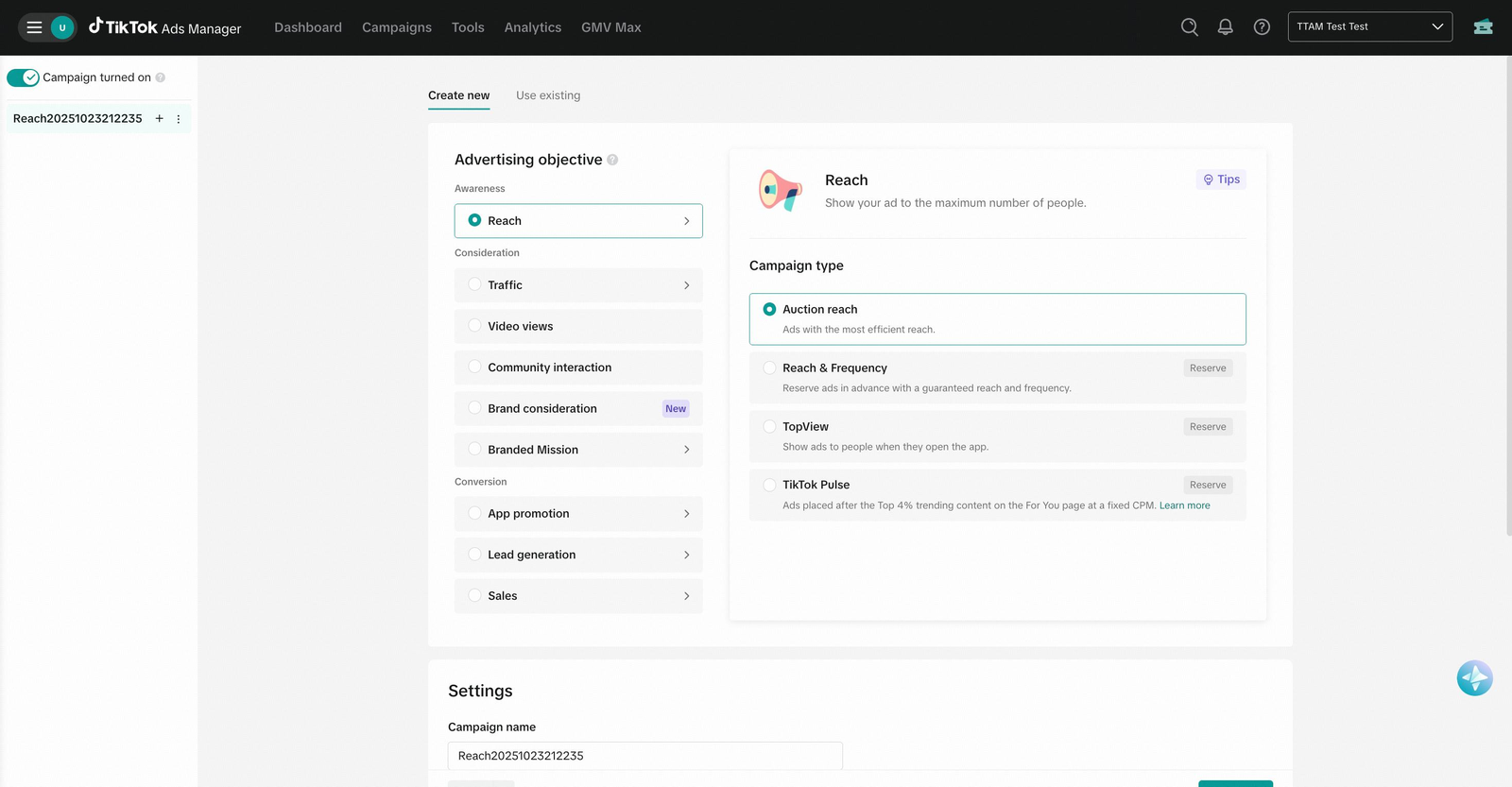
An example objective selector with Reach selected. Choose the objective that matches the intended business outcome; this example is not a recommendation to use Reach for every campaign.
Campaign Level: The top level where you set the advertising objective (Objective). If using Campaign Budget Optimization (CBO), the overall budget is also set here.
Ad Group Level: The level where you define the audience, placements, budget (in ABO optimization), and bidding strategy (Bidding).
Ad Level: The visual asset - the video, text, and call-to-action (CTA) button.
The Golden Rule of Structure: Lanoue emphasizes that a correct structure is based on isolating a single variable at each level. The ad group level is designed to find winning audiences, and the ad level is designed to find winning creative.
Setting Campaign Objective and Learning Budget
For a sales or lead-generation goal, choose the currently available objective and optimization event that match that outcome. Demand Curve's historical guide advises against substituting a Traffic objective merely to obtain cheaper clicks.
Daily budget planning example: Demand Curve's historical guide uses 50 weekly conversions as a planning assumption: target CPA x 50 / 7. This is not a current universal exit threshold. TikTok's June 2026 Learning Phase page says volatility typically starts declining after about 25 campaign results or 7 days, without guaranteeing that every campaign then succeeds. Keep the historical calculation separate from the current platform description. Source:https://ads.tiktok.com/help/article/learning-phase
Example: If the target CPA is $35, the calculation is: $35 * 50 = $1,750 per week, divided by 7 = $250 daily budget.
Alternative Rule of Thumb for Budgeting: The agency eComAmplify offers an alternative rule of thumb for initial testing: setting a daily budget of 3 to 5 times the target CPA for each ad group, in order to generate sufficient signals in the first few days.
Overall Budget Allocation: Demand Curve recommends allocating 10% to 30% of the business's main advertising budget to TikTok. Of this amount, it is recommended to direct approximately 85% to Prospecting campaigns and creative testing, and 15% to retargeting campaigns. The timeframe for evaluating account performance stands at 6 to 10 weeks.
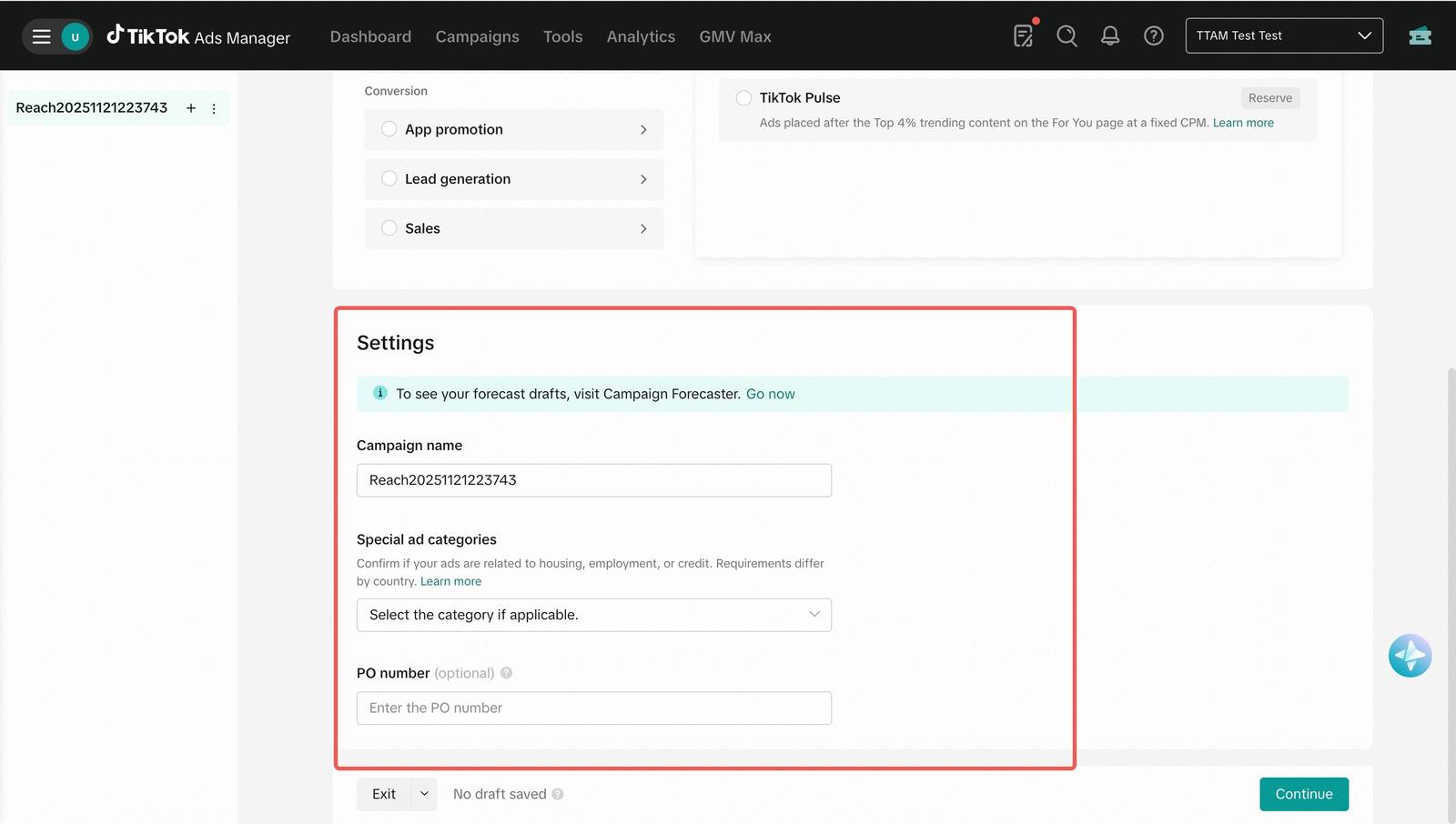
Campaign-level naming and category settings. Budget and bidding controls are not shown in this crop.
Numbered Steps for Campaign Setup and Work Structure
According to the combined experience of Demand Curve, eComAmplify, and Spencer Lanoue, the recommended sequence of actions for setting up a first campaign is:
Setting up a Creative Testing Campaign: Demand Curve recommends isolating creative testing in a separate campaign. In this campaign, run 3-4 ad groups, placing 3 to 6 significantly different ads (Big Swings) in each group.
Creative testing: eComAmplify recommends 3 to 5 creatives per ad group. The 280% conversion-lift figure for 21-to-34-second videos comes from TikTok's December 21, 2021 analysis, not a current rule about ideal length or a promised gain. TikTok's own article allows shorter or longer videos when appropriate. Test length for the actual audience, offer and objective. Source:https://ads.tiktok.com/business/en-US/blog/creative-that-drives-conversions
Setting Audience Targeting: Demand Curve and Spencer Lanoue recommend starting with Broad Targeting without interest restrictions, letting the algorithm find the buyers.
Targeting by Creator Behavior: Demand Curve clarifies that Creator Interaction targeting allows defining users who watched or followed a creator category (such as DIY or skincare), rather than followers of a specific creator.
TikTok's Customer File help lists email addresses, phone numbers and Mobile Advertiser IDs as supported identifiers for CSV or TXT uploads. Both hashed and original values are accepted under its formatting requirements. Check current account eligibility, matching and minimum-audience requirements. Source:https://ads.tiktok.com/help/article/customer-file
Choosing Ad Group Structure: Spencer Lanoue presents three structural methods to choose from:
Method A – Audience Segmentation: A single conversion campaign including a broad audience group, an interest group, a Lookalike group (1% of purchasers), and a retargeting group (cart abandoners in the last 30 days). The same 3-5 ads are run across all groups.
Method B – Tiered Interests: Splitting topics into only 1-3 similar interests per ad group to prevent data overlap.
Method C – Creative-First CBO: Running CBO (e.g., $200/day), a single ad group with broad targeting, and adding 7-10 different UGC videos. The algorithm automatically routes budget to the video attracting the relevant audience.
Allowing time before changes: one practitioner approach is at least three full days and warns against large bid changes. These are testing heuristics, not universal stopping rules or proof that any change above 20% automatically resets learning. TikTok separately advises budget increases of no more than 40% during learning or 30% afterward, with at least two days between adjustments. Budget and bid changes are different controls. Sources:https://ads.tiktok.com/help/article/learning-phase andhttps://ads.tiktok.com/help/article/budget
Errors Reported by Advertisers
Advertisers in professional communities report several common failures when launching campaigns:
Traffic quality versus funnel outcomes: in a June 14, 2026 Reddit post, u/Mysterious-Honey1457 described a Traffic campaign optimized for landing-page views at about $20/day. The body reports roughly 3% CTR and $0.45 per landing-page view, despite the title calling that figure CPC. Its lifetime funnel combines paid and organic traffic: about 3,800 landing-page views, 19 first actions and approximately zero sign-ups. The reported 13% direct/word-of-mouth versus 1% TikTok engagement gap is a diagnostic observation, not proof of one cause. Do not restate it as zero actions from every paid visit or zero sales in a product-sales campaign. Source:https://www.reddit.com/r/TikTokMarketing/comments/1u5wwku/3_ctr_045_cpc_0_conversions_on_tiktok_is_this_a/
Creative volume: the practitioner guides recommend limiting the number of simultaneous test ads so each receives meaningful spend. Their suggested counts are planning heuristics, not proof that a seventh ad always stalls delivery.
Audience overlap: Lanoue advises avoiding heavily overlapping test groups. Review exclusions and delivery rather than assuming that any overlap necessarily causes a specific cost increase.
Disorganized naming conventions: Spencer Lanoue recommends using a fixed naming structure: Date_CampaignObjective_AudienceDescription (such as 10-25_Conversions_LAL1-Purchasers_US), to prevent confusion when analyzing data.
Where Sources Differ or Are Unclear
1. Using ABO vs. CBO in the Initial Testing Phase
Spencer Lanoue (Trypostbase) and Demand Curve's guide recommend starting with Ad Group Budget Optimization (ABO) during the testing phase. This approach provides full control and ensures that each target audience receives an equal budget for testing. Conversely, Spencer Lanoue himself presents an opposing method (Method 3), where Campaign Budget Optimization (CBO) is enabled right from initial testing, using a single broad group containing 7-10 UGC videos. In this method, advertisers rely on the algorithm to identify which creative works and shift budget to it automatically.
2. Bidding Strategy in a New Account
In a May 2024 discussion about a new account with about five conversions, u/Wooden-Emergency1719 recommended continuing conversion optimization and aiming to pass learning in under ten days. The retrieved comment does not specify Lowest Cost. u/Fantastic_Tart_2366 instead suggested waiting for roughly 20 sales, then testing CBO with value bidding before cost/bid caps. These are conflicting anonymous recommendations, not established requirements or assured timelines. Source:https://www.reddit.com/r/TikTokAds/comments/1ctoqun/best_bid_strategy_approach/
3. Availability of Advanced Formats in Self-Serve Accounts
Demand Curve's historical guide describes restrictions on Collection Ads and Dynamic Product Ads in self-serve accounts. Do not use that old description to decide current eligibility. Check the formats available in the current account and market.